Project Hail Mary - Andy Weir
Physics formulas revise
As someone who is very sensitive with the numbers, while reading the book Project Hail Mary I noticed there are many numbers and formulas throughout the book. These numbers and formulas are not trivial to me as I have forgotten most of these physics formulas and any math cannot be done solely in my head need to writen down. So I decided to note down all of my discoveries throughout the journey reading the book.
How will it go? For each math formula mentioned in the book, I quote it into the article along with the math formula and physics concepts related.
Chapter 1
Gravitational acceleration
Anyway, the table’s underside is 91 centimeters from the floor
I time how long it takes to hit the ground. I get about 0.37 seconds.
0.348 seconds. Distance equals one-half acceleration times time squared. So acceleration equals two times distance over time squared.
It’s 15 meters per second per second when it should be 9.8.
The narrator is trying to calculate the gravitational acceleration based on the duration t of a free-falling object over a distance d
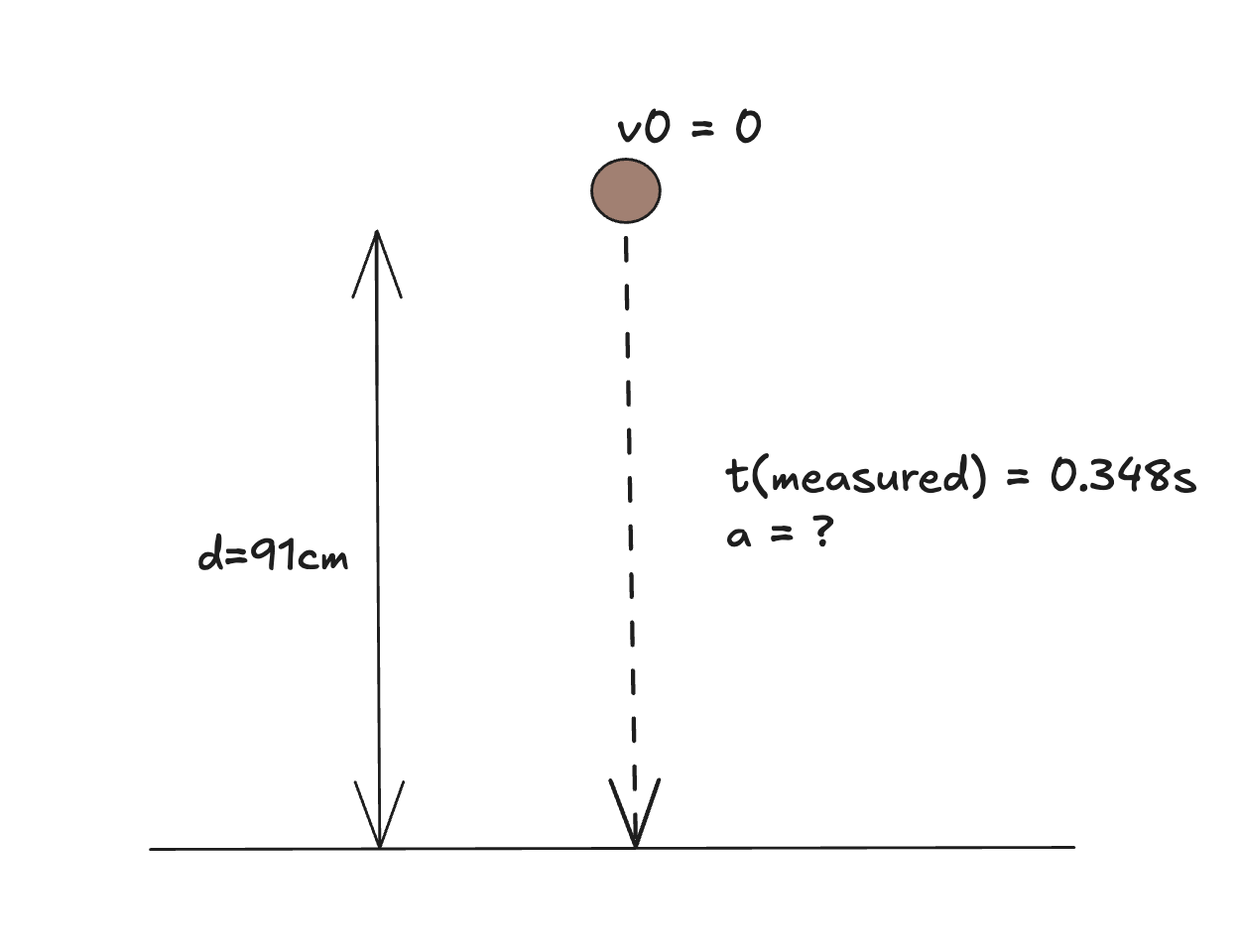
We have the formula of free fall
In this case, we have d = 0.91 meters, t = 0.348 seconds. Hence the value of gravitational acceleration should be 15 meters/seconds/seconds
Chapter 2
Centripetal acceleration and Period of pendulum
I could be in a centrifuge
How big would that radius have to be?
Dropping things off a table and timing them is all well and fine for rough estimates, but it’s only as accurate as my reaction time on hitting the stopwatch. I need something better. And only one thing will do the job: a small piece of string.
I have a pendulum.
That period ends up being driven by two things, and two things only: the length of the pendulum and gravity.
When I hit the ten-minute mark, the pendulum is barely moving anymore, so I decide that’s long enough. Grand total: 346 full cycles in exactly ten minutes.
I measure the distance from the hatch handle to the floor. It’s just over two and a half meters.
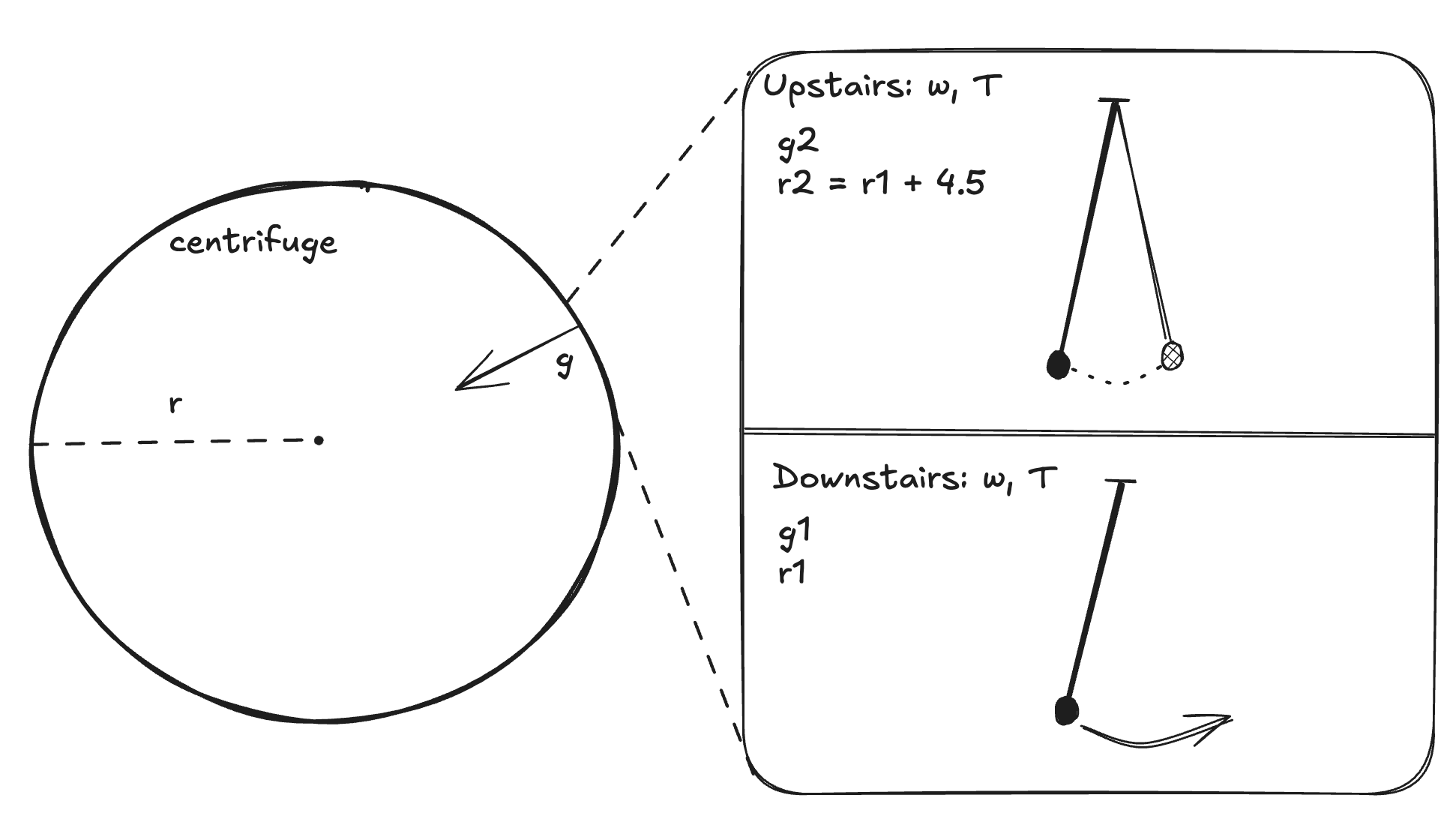
My pendulum is now four and a half meters lower than it was before.
The result: 346 cycles. Same as upstairs.
“Thing is, in a centrifuge, the farther you get from the center, the higher the centripetal force will be. So if I were in a centrifuge, the “gravity” down here would be higher than it was upstairs. And it isn’t. At least, not enough to get a different number of pendulum cycles.”
In chapter 1, the narrator used free-fall formula to estimate value of grational acceleration based on the duration of an object falling from the table. In chapter 2, the narrator believed he was inside a huge centrifuge and wanted to find its radius.
Period of a Simple pendulum
The formula for the period T of a pendulum is T = 2π Square root of (L/g) , where L is the length of the pendulum and g is the acceleration due to gravity; assuming small oscillation angles.
The narrator measured the period of the pendulum twice: once downstair and once upstair (a height difference of 4.5 meters). Both measurements yielded 346 cycles in 10 minutes, meaning the period T was the same in both locations. Calling them T1 and T2, we have T1 = T2. Because the length of the pendulum remained the same, we have g1 = g2.
Centripetal acceleration
Centripetal acceleration a is the acceleration experienced while in uniform circular motion. It always points toward the center of rotation.
Angular velocity ω is the rate of rotation (radians per second)
In a centrifuge (a rotating ship), "gravity" is actually centripetal acceleration caused by the rotation. So we have these equations for the 2 measurement
Because angular velocity does not change inside the centrifuge, we have this equation
Since g1 = g2 implies r1 = r2, and r2 = r1+4.5, the 4.5-meter difference must be negligible compared to r1, meaning r1 is very large. That gives the narrator a sense of the size of the centrifuge he was in.
?
According to my math (and I showed all my work!), that centrifuge would need a 700-meter radius (which is almost half a mile) and would be spinning at 88 meters per second—almost 200 miles per hour!
Whizzing through the air at 200 miles per hour?
The radius would have to be 1,280 meters—close to a mile.
Chapter 3
Linear velocity
“The solar disc is 27 centimeters on-screen and the sunspots are 3 millimeters. And they moved half their width (1.5 millimeters) in ten minutes. Actually, it was 517 seconds, according to my stopwatch. I scribble some math on my arm.
At this resolution, they’re moving 1 millimeter every 344.66 seconds. To cross the entire 27 centimeters it would take (scribble, scribble) just over 93,000 seconds. So it’ll take that long for the cluster to cross the near side of the sun. It’ll take twice that long to get all the way around. So 186,000 seconds. That’s a little over two days.”
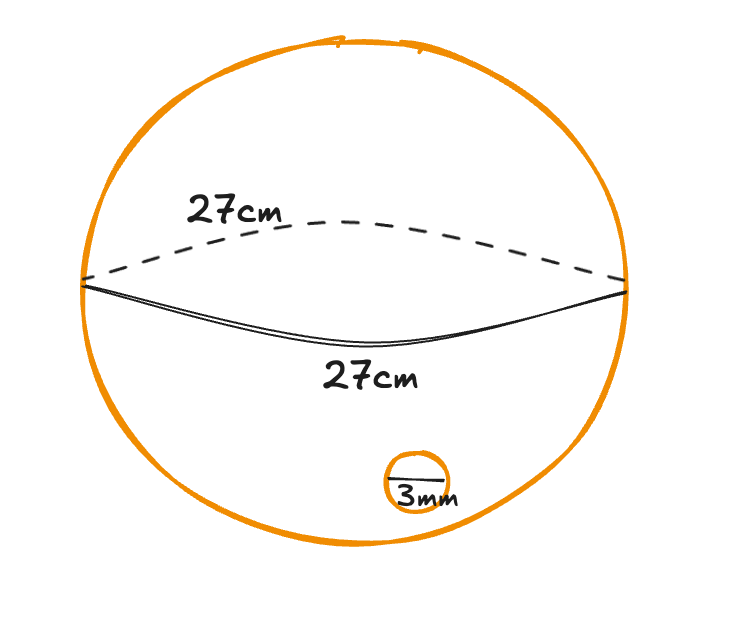
The sun was travelling 3 millimeteres in 517 seconds, so 1 millimeter took it 517/3 = 344.66 seconds. So 27 centimeters would take 344.66 x 27,0 = 93,058 seconds. The entire sphere would take 93,058 x 2 = 186,116 seconds.
Chapter 4
I check the Astrophage panel to refresh my memory.
REMAINING: 20,862 KG
CONSUMPTION RATE: 6.043 G/S
Anyway, I don’t know exactly how the consumption rate will change over time (I mean, I could work it out, but it’s complicated). So for now I’ll just approximate it to 6 grams per second. How long will that fuel last?
Grand total, I’ll run out of fuel in about forty days.
We have remaining fuel weighs 20,862kg; current consumption rate is 6.043 gram/second. So the approximate time it would take to consume all the fuel is 20,862 x 1000 / 6 = 3477000 seconds = 40.24 days
Chapter 5
Einstein’s mass-energy relation
“Astrophage cell is now seventeen nanograms heavier. You can see where this goes, yes?”
“Oh my God.” I was giddy. “Seventeen nanograms…times nine times ten to the sixteenth…1.5 megajoules!”
Mass conversion. As the great Albert Einstein once said: E = mc 2
Chapter 6
Power
The engines consume 6 grams of Astrophage per second. Astrophage stores energy as mass. So basically, the spin drive converts 6 grams of mass into pure energy every second and spits it out the back.
“I use it to calculate the mass-conversion energy of that 6 grams…good Lord. It’s 540 trillion Joules. And the ship is emitting that much energy every second. So it’s 540 trillion watts. I can’t even fathom that amount of energy. It’s considerably more than the surface of the sun. Literally. Like…you would get hit by less energy if you were on the surface of the sun than if you were standing behind the Hail Mary at full thrust.”
That gives us the fact that the ship is emitting 540 trillion watts.
Chapter 7
Right Triangle Trigonometry
“Range” is 217 meters. I’m assuming that’s the distance to the closest part of the other ship. Or maybe the average. No, it would be the closest part. The point of this system is probably to avoid collisions.
Another reading, “Angular width,” is 35.44 degrees. Okay, some basic math should handle this.
“I bring up the Utility panel on the main screen and launch the calculator app. Something 217 meters away is occupying 35.44 degrees of the view. Presuming the radar can see in all 360 degrees (it would be a pretty cruddy radar if it couldn’t)…I type some numbers into the calculator to do an ARCTAN operation, and:
The ship is 139 meters long. Roughly.”
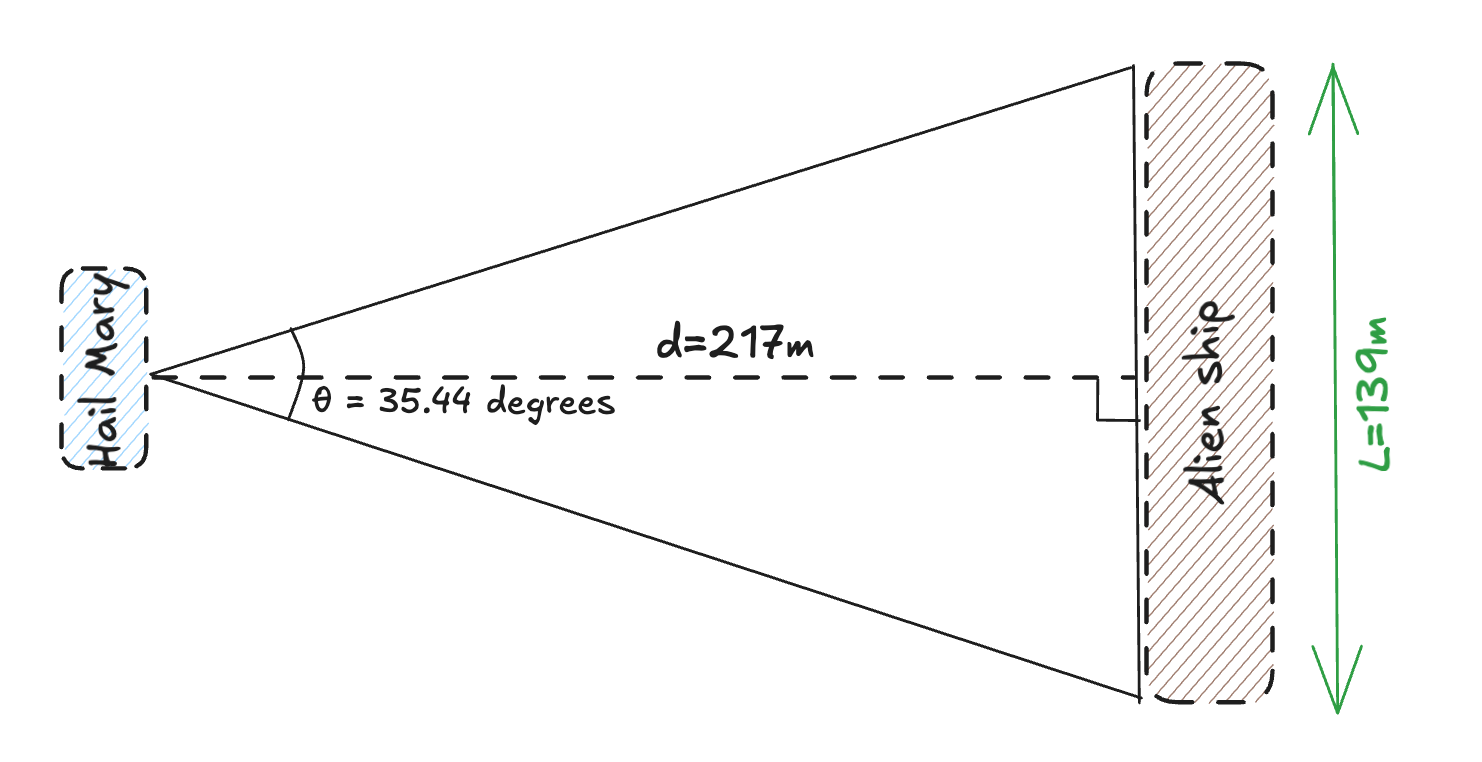
That gives the fact that the ship is roughly 139 meters long.
Chapter 8
Speed distance time
The Blip-A has stopped spinning—probably did it when the Hail Mary stopped. And it’s still 217 meters away.
Blip-B is plugging along at over a meter per second. I only have a few minutes to suit up!
The narator has 2-3 minutes (217 seconds) until the Blip-B reached the Hair Mary ship.
Chapter 9
Einstein’s mass-energy relation
One point eight billion Joules of light energy was released. This is why we needed vacuum chamber and one thousand kilograms of silicon.
“Wait…how much Astrophage did you use there?”
That Mr. Einstein with his E = mc2
Dimitri smiled. “I can only estimate based on thrust generated. But was close to twenty micrograms.”
This mean 20 micrograms Astrophage as fuel were converted to energy.
Special Relativity and Newton's Second Law of Motion
“Experiment done.” He leaned forward to read the screen. “Sixty thousand Newtons of force!”
He pumped his fist in the air. “Yes! Sixty thousand Newtons! Maintained for one hundred microseconds!”
Special Relativity
The momentum of a single photon
the formular is derived from Einstein’s full energy-momentum equation from Special Relativity in case photon has no rest mass m = 0
Newton’s Second Law of Motion
The net or resultant force acting on an object is equal to the rate of change of momentum.
For just a fraction of a second, that light alone could push a spaceship with 60,000 Newtons of force.
Chapter 10
Mechanical odometer
How Eridian numbers work (base six)
I start the timer just as the third rotor changes state.
It takes around a minute and a half for the third rotor to move just one step. I can expect to be at this for ten minutes or so. But I plan to watch the whole time.
Total time: 511.0 seconds. I don’t have a calculator, and I’m too excited to go back into the ship to get one. I pull out a pen and do long division on the palm of my other hand. One Eridian second is 2.366 Earth seconds.
The Mechanical Clock:
Rotor 1: 1 lap = 6 = 6 units.
Rotor 2: 1 lap = 6 x 6 = 36 units.
Rotor 3: 1 lap = 6 x 6 x 6 = 216 units.
The total Earth time for one full cycle of the third rotor is 511 seconds, so 511 Earth seconds is corresponding to 216 Eridian units/seconds. 511/216 = 2.366 Earth seconds is corresponding to 1 Eridian second.
Chapter 12
Density
“I pull a pair of calipers out of the toolkit I keep in the tunnel and measure the sphere’s diameter. It’s 4.3 centimeters. From that I work out the volume, multiply by the density of iron, and get a much more precise and accurate mass of 328.25 grams.
References
Pendulum: https://www.britannica.com/technology/pendulum
Centripetral acceleration: https://www.britannica.com/science/centripetal-acceleration